
My interest in DEI – or Diversity, Equity and Inclusion – may well have started off from a different angle. I was having a conversation with a PR leader of a very well-known organisation that had been through quite a period of turbulence. It still is. The trigger point could be said to have been self-inflicted, so I was interested why the organisation had chosen to expose itself in such a way. “Groupthink” was the reply.
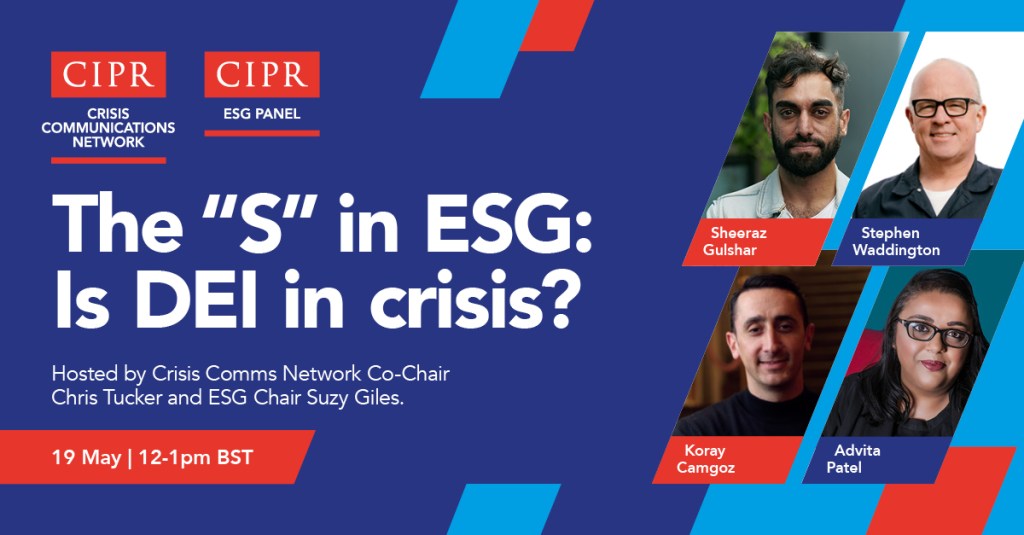
The PR leader explained that, as they saw it, everyone around the decision-making table was very similar in terms of background and outlook. The decision that caused the trouble and led to the crisis was taken without anyone representing the views of the organisation’s stakeholders, because quite simply none of those executives came from that stakeholder group. That got me thinking and led ultimately to the Crisis Communications Network’s forthcoming joint event on May 19th with the CIPR ESG Panel “The ‘S’ in the ESG – is D, E & I in crisis?” Details of the panel and how to register are at the end of this blog.
It is well-documented that when it comes to crisis and reputation management, organisations with diverse management teams will be better positioned to manage the situation more effectively. ISO 22361:2022, the international standard when it comes to crisis management, highlights the dangers of ‘groupthink’, ‘stereotyping’, and ‘confirmation bias’ when making decisions about handling a crisis. Having a diverse management team able to understand and empathise with stakeholders from a variety of backgrounds should counteract much of that.
And of course, there are questions about the diversity of the PR profession itself. In its PR Population Report the CIPR found significant disparities in the PR profession’s demographic makeup. For example: while women comprise 60% of practitioners, they hold only 46% of director-level positions. 50% of women in PR are under 35, compared to 36% of men, suggesting many female practitioners face barriers to progression that force them out of the profession prematurely, resulting in a critical loss of expertise and diversity at senior levels.
While women comprise 60% of practitioners, they hold only 46% of director-level positions.
CIPR PR Population Report
The report also highlighted broader diversity challenges, with 87% of practitioners being from white backgrounds, increasing to 90% at director level.
So, crisis communicators should be concerned by diversity both within their profession and that of their organisations’ management teams. My belief is that this needs to be diversity of thought and background, as well as of more obvious characteristics such as race, ethnicity, gender, age and sexual orientation, all of which contribute to a better range of thinking and ideas.
It would seem as if Britain’s foremost emergency planner, Professor Lucy Easthope, agrees with these sentiments when she says: “I talk in my book (“When the dust settles”) about the ‘wildcard’ role within high performing teams. That there has to be a person in the team being the dissenting voice, suggesting ‘what if’ ideas. Courageous leadership (in a crisis) is also about building high performing teams that include a mixture of people with different perspectives.”
But let’s look at how the more mainstream ideas of diversity – or DEI – have fared recently and the crisis communication challenges they now present.
Initiatives to improve diversity in management teams have been with us for quite some time, decades even. However, the wider issue of what has become known as DEI was propelled into mainstream discussion with the racial justice protests after George Floyd’s death in 2020. The Black Lives Matter movement coalesced with the LGBTQ+ rights activism, and #MeToo movement, which also hit the mainstream round about the same time.
DEI policies included actively seeking to attract more diverse talent pools; strategies to eliminate bias in recruitment, such as more standardised interview and selection processes; and partnering with bodies that supported underrepresented groups to access more diverse employment candidates.
Organisations, especially in the US, but then also the UK, began to respond by adopting DEI policies. These policies included actively seeking to attract more diverse talent pools; strategies to eliminate bias in recruitment, such as more standardised interview and selection processes; and partnering with bodies that supported underrepresented groups to access more diverse employment candidates.
DEI also required changes in workplace culture, and we saw organisations seeking to bring these about by providing training to employees on unconscious bias; harassment prevention; the use of more inclusive language; and the formation of Employee Resource Groups, which sought to provide a safe space for employees with shared identities or interests to connect and advocate for their needs.
However well-intentioned such policies might have been, they did cause organisational crises for some. The Royal Air Force (RAF) faced a “DEI crisis” after a diversity drive, aimed at increasing representation of women and ethnic minorities, led to unlawful discrimination against white male candidates, resulting in a pilot shortage and a public outcry.
In September 2022 the Ministry of Defence were forced to admit “some mistakes were made”, when an internal inquiry revealed that the pressure to meet recruitment targets had led to unlawful positive discrimination, with at least 31 men held back in training.
Oxfam faced criticism over its inclusive language guide. The guide’s suggestions to avoid terms like “mother” and “father” in favour of “parent” or “parents” and “people who become pregnant” instead of “expectant mothers” were particularly criticised.
For Oxfam the intention was to avoid reinforcing gender stereotypes and to be more inclusive of transgender and non-binary people. But for some, being told the word “headquarters… implies a colonial power dynamic”, “aid sector… cements ideology where an agent with resources gives support on a charitable basis” and the term “field trip” can “reinforce colonial attitudes” was a step too far.
In the US, arguably the home of DEI, a backlash was mounting. The most significant manifestation involved challenges to race-based affirmative action policies, especially in college admissions. In 2023, the U.S. Supreme Court’s ruling in Students for Fair Admissions v. Harvard (and other related cases) effectively banned the consideration of race in college admissions.
A White House statement in January 2025 described DEI programmes as “illegal and immoral.”
The backlash went into overdrive once President Trump was elected. A White House statement in January 2025 described DEI programmes as “illegal and immoral.” It called for their termination across the federal government, arguing that these initiatives constituted discriminatory practices rather than promoting equality.
The impact on corporate America was swift. Organisations like Amazon, Google, Meta, Target, and Walmart were among those racing to amend or scrap DEI policies. Whilst others such as Apple and Delta Airlines went public on their decision to stick to their DEI promises. This change in climate has had an impact on the UK also.
The Bank of England’s regulatory arm, the Prudential Regulation Authority (PRA), and the Financial Conduct Authority (FCA) have said recently they will not bring in new diversity and inclusion rules for financial firms because they want to avoid imposing extra “regulatory burdens” and costs. BT is said to be scrapping diversity measures in its manager bonus scheme, having told major investors that it intends to replace the DEI component of its scorecard with a measure of employee engagement.
The screeching of brakes on DEI policies has caused particular problems for multi-national companies. Whilst McDonald’s US division has scrapped targets for minority representation in senior roles, rebranded its diversity department and abandoned DEI requirements for suppliers, the British business says its own pledges remain intact and it will press ahead with requirements that 40% of senior leadership roles are held by under-represented groups by 2030 and strengthen “social inclusion” across its supply chains.
The current DEI landscape for PR professionals was summed up in a recent Harvard Business Review article as, in a nutshell, we can find ourselves in a crisis for talking too much about DEI or indeed for not talking enough about it.
The current DEI landscape for PR professionals was summed up in a recent Harvard Business Review article as, in a nutshell, we can find ourselves in a crisis for talking too much about DEI or indeed for not talking enough about it. Media outlets and activists are trawling organisations’ websites looking for examples of DEI initiatives which can be spun in a damaging way. But the DEI risks are legal as well as reputational. Getting the language right is crucial as being seen to give preference to certain groups – rather than removing barriers – could be seen as promoting discrimination. Time to talk to the lawyers.
Certainly, time also to stand back and look at what your organisations are seeking to do in this important field. A knee-jerk reaction to the backlash coming out of the US could well be a dangerous one. A communications strategy rooted in a good understanding of all our stakeholders and what they expect from us is required. Stephen Waddington in a recent Substack post sought to create a useful framework to guide our thinking. And here at the CIPR Crisis Communications Network we are doing our bit to help with a Webinar we are hosting jointly with the CIPR ESG Panel – “The ‘S’ in the ESG – is D,E & I in crisis?” at 12.00pm on Monday, May 19th.
Stephen will be speaking along with Founder of CommsRebel and current CIPR President, Advita Patel, Sheeraz Gulsher, Co-Founder of ‘People like us’ and Koray Camgöz, CEO of the Taylor Bennett Foundation. With so much experience around the table on this issue we are hoping for much light as well as possibly a little heat! Register here
By Chris Tucker, Chair, CIPR Crisis Comms Network
Discover more from
Subscribe to get the latest posts sent to your email.