Upcoming Events
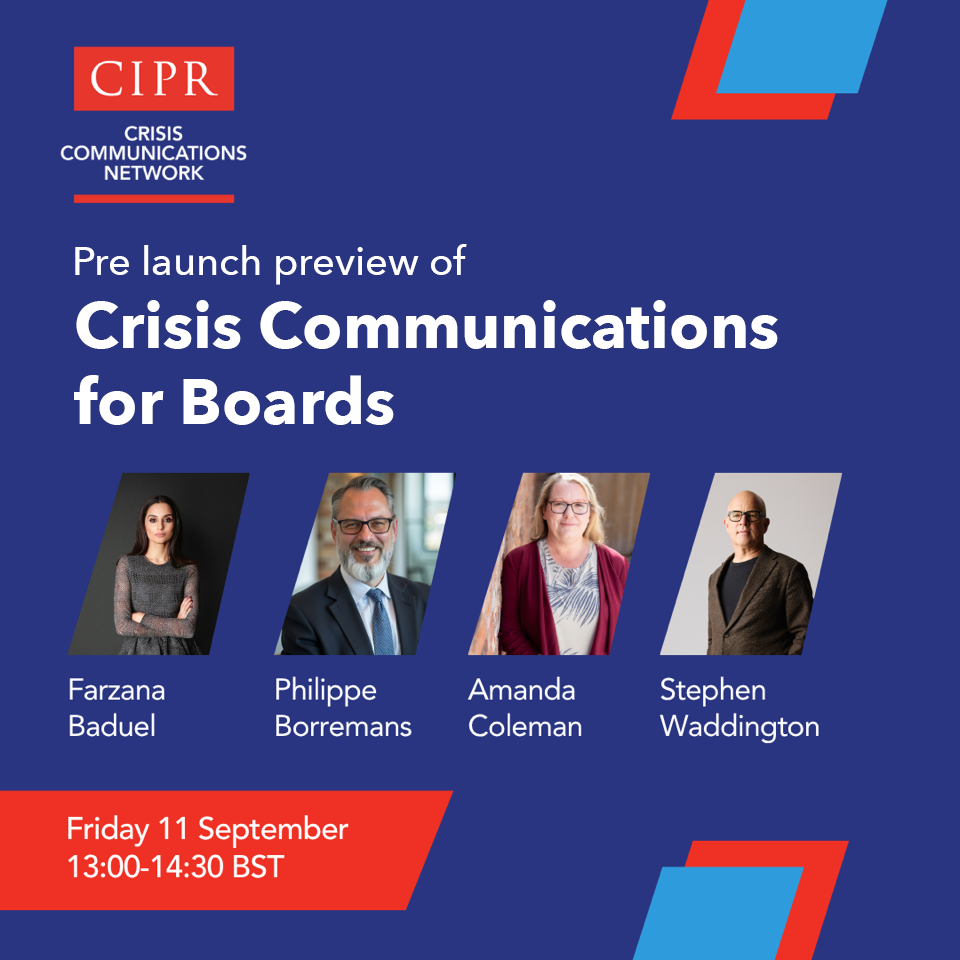
Join us for an exclusive pre- launch preview of Crisis Communication for Boards, written and published by the CIPR Crisis Communications Network. Our new handbook, which is published as part of a new partnership with the Institute of Directors (IOD), promises to educate C-suite and board members in the basics of crisis communication and what good crisis communication looks like from a board perspective.
It will demonstrate how strategic communication is a core component of good governance that no board can be without; and it will also promote the value that communications professionals can bring to the boardroom, positively influencing strategy and delivery, proactively helping boards to detect, prepare for and manage risk and crisis.
Structured around the full crisis lifecycle, the handbook takes a broad strategic perspective whilst also providing templates for best practice, special features and case studies from leading academics and practitioners from around the globe. By registering for this event, you’ll receive an exclusive copy of the handbook ahead of its official release date on Monday, 14 September.
The event will be hosted by CCN Co-chair Katherine Sykes. It will feature both committee members and globally recognised crisis experts, all of whom have contributed special features and case studies to the handbook:
The event will take place on Friday 11 September from 1.00- 2.30 PM BST. In recognition of the 25th anniversary of 9/11, proceedings will begin with a short period of reflection and remembrance.
Attendees will earn 5 CPD points.
Past Events

Since 2024, the CIPR Crisis Communication Network has hosted an annual webinar, in November, on the landmark ‘Reputation, Risk and Resilience’ report published each year by our Special Advisor, Rod Cartwright.
This year, by contrast, we changed things up by holding an extended two-hour online Symposium on the report’s 2026 edition (published in mid-May) and centred on its core theme of ‘Assuming Agency and Achieving Balance in the Age of Angst and Rage’.
That leitmotif acted as the central reference point for a truly global panel of experts, drawn from top-tier business, academia and reputation and resilience consulting.
The session started with a typically provocative 30-minute presentation by Rod Cartwright on his latest report, its key findings and the practical frameworks for action it contains.
We then heard from four world-class speakers on their respective expertise, experience and specific thinking, all through the central lens of agency and balance. Our Symposium Speakers were:
- Aaron Marks, a Virginia-based specialist in threat, risk and resilience, and leading thinker on ‘The Grey Zone’
- Craig Badings, Partner at SenateSHJ, originator of the Crisis 300 Index and Author of Future of Reputation 2030 – originally from South Africa, but based in Sydney
- Professor Lee Edwards, Professor of Strategic Communications and Public Engagement at the London School of Economics
- Mary-Ann Anyikam, Head of Global Resilience at HP, based in Texas
We concluded with a 20 minute facilitated ‘plenary’ audience Q&A and discussion, with the full line-up of speakers.
‘Reputation, Risk and Resilience’ 2025 was downloaded in 67 countries across six continents, underlining its status as global reference source for specialists in issues, crisis, reputation, risk and resilience – as well as for leaders overall.
Combined with a world-class panel and an even more striking 2026 edition – delivered in partnership with AMEC, CIPR, EACD, ICCO, Ipsos, Roxhill Media and PRovoke Media – this Symposium wasn’t one to miss.
Crisis Comms AI Month Series

Our second event in the special series, ‘Crisis Comms AI Month’, helped practitioners to understand the ways in which they might apply AI effectively, ethically and at scale throughout PR processes and strategies.
Crisis Communication Network committee members Sara Naylor and Rosie Hamilton hosted industry leader Ben Verinder, who co-authored AI for Public Relations with Stephen Waddington, which was published on 4 May 2026.
As well as actionable tips and insights about implementing AI for crisis (and many other types of) communication, the book also explores the risks posed to reputation by AI and how PR practitioners can mitigate those risks in order to avoid public difficulties. This session covered both of these topics.
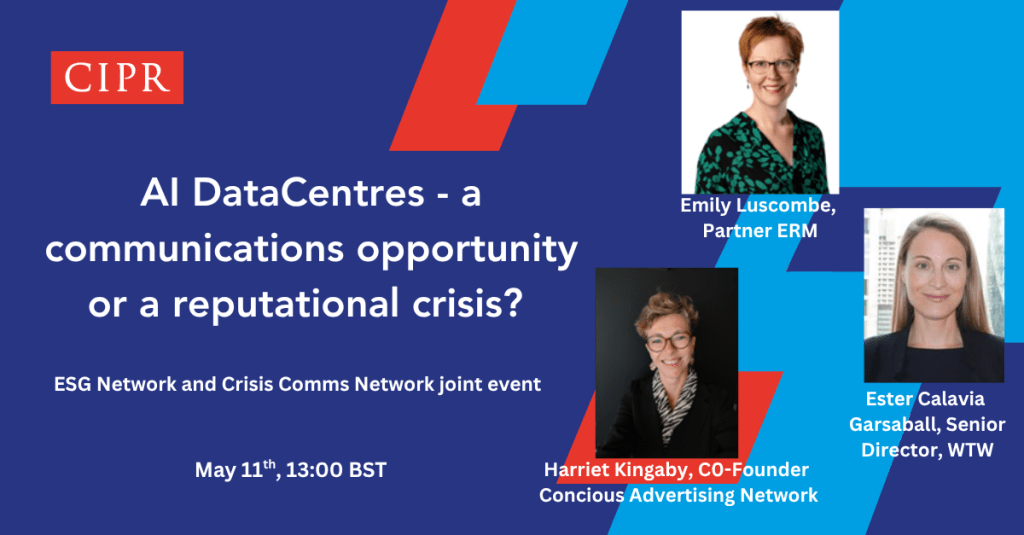
While AI use continues to dominate our conversations, in the sustainability communications world, how we manage the narrative around the environmental impact of AI is what concerns us.
How can we best advise our organisations/clients around the impact of their use of AI and are we getting all the information we need from data centre providers – or are we in greenwashing territory?
Our session aimed to answer questions we have on the impacts of AI use on the environment, as well as societal issues/benefits, and how the communications profession can approach it. To discuss this, we are brought together three experts with unique perspectives and experiences:
- Harriet Kingaby is Co-founder and Co-chair of the Conscious Advertising Network and widely recognised for her work on climate change misinformation, greenwashing and conscious advertising.
- Emily Luscombe is EMEA Communications Agency Lead and Partner for ERM, the world’s largest sustainability consultancy. Emily advises clients globally on strategic sustainability communications.
- Ester Calavia Garsaball is Senior Director and Head of Natural Catastrophe & Risk Financing at Willis Towers Watson’s Climate Practice.
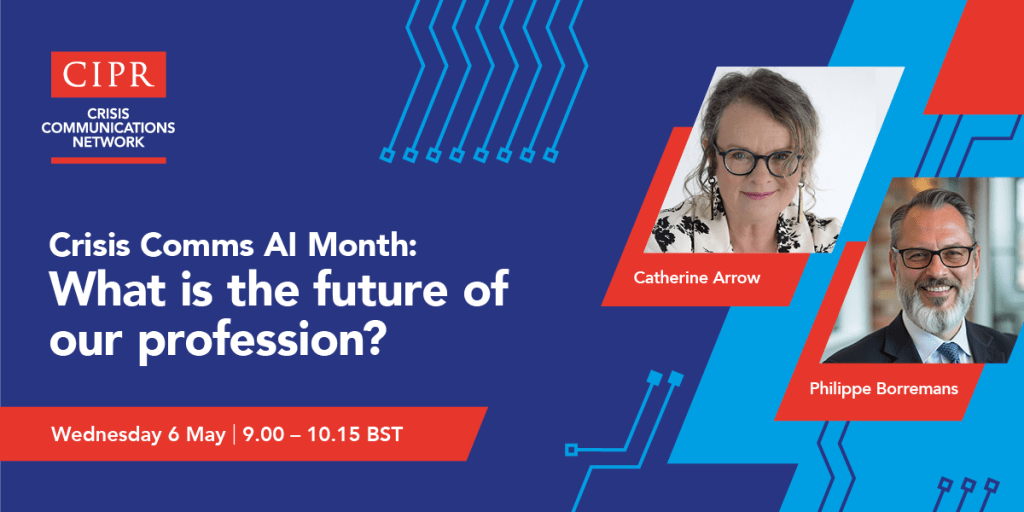
Will crisis communications practitioners still be relevant in 2030? With AI already creating crisis comms strategies, drafting statements and press releases, and guiding decision making – what role will we, as individuals, play in the future of our own profession?
This webinar explored the future of our profession through the lens of AI. Is AI a threat to what we do, an opportunity, or both? How do you secure your AI readiness, and what should your organisation be doing right now?
To explore those questions, we are joined by two highly respected figures at the intersection of AI and communications:
Philippe Borremans has been exploring how artificial intelligence can be leveraged in crisis communication scenarios since the early days of AI adoption. He publishes Wag The Dog, a widely read weekly newsletter dedicated to AI and communications, and authored one of the first books to examine the role of AI in crisis communication strategy and execution. Most recently, he surveyed over 100 crisis communication professionals on their AI readiness, as well as published his second publication: Building your Crisis Communication Plan, the Complete Step-By-Step Workbook for 2026.
Borremans has held several leadership positions including President of the International Public Relations Association (IPRA 2021), Vice President of the International Association of Risk and Crisis Communication (IARCC), and board member of the European Association of Communication Directors.
Catherine Arrow is the founder and executive director of PR Knowledge Hub, a digital communications pioneer, and a leading voice on the integration of AI with communication practice. Over the last decade, she has been exploring and shaping the understanding of AI’s transformative impact on public relations and society.
Her most recent publication, Divided on Purpose: Global Risks 2026, “tries to make sense of what is happening around them and ahead of them”. It sets out ten major risks shaping 2026, including AI, explaining what is happening, why it matters, and how it may impact your job.
Catherine is a Life Member and Fellow of the Public Relations Institute of New Zealand, Fellow of the Chartered Institute of Public Relations and an Accredited Fellow, Public Relations ASEAN Network. She is currently a member of the International Advisory Board for FerpiLab, Italy and a standing member of the Commission on Public Relations Education’s (CPRE) research panel. She was also voted ‘Global Public Relations Practitioner of the Year’ at the 2025 Global Alliance Awards.
The event was chaired by Felix Östman, Event Manager of the CIPR Crisis Communications Network.
This webinar was part of Crisis Comms AI Month, a series of events hosted by the CIPR Crisis Communications Network examining the growing role of artificial intelligence in crisis communications practice.

A Joint CIPR Crisis Communications Network, MEPRA and ICCO Open-House Drop-In Session
Since the attacks on Iran launched at the end of February, the escalation and expansion of the conflict currently playing out across the Middle East has seen communications professionals grappling with a new reality – professionally and personally.
The 8th April announcement of a two-week ceasefire will provide some welcome respite. However, the combination of Israel’s operations in the Lebanon seemingly being excluded from the ceasefire, previous US-Iran negotiations having twice been abruptly ended by US military action and the continued on-the-ground ripple effects of recent events weeks means potential peace talks are unlikely to expel entirely ongoing day-to-day uncertainty on the ground.
With so little certainty about the ultimate trajectory, duration, extent and nature of events, senior communicators are juggling the challenges of ensuring business continuity and building resilience with day-to-day service delivery, team motivation and protecting staff wellbeing, in an ever-more uncertain environment.
As analysis by PRovoke Media has shown, judgements around tone and timing are both constant and consequential, as communicators work to manage and bridge the gap between external perception and on-the-ground reality.
At the same time, demand for geopolitical insight is rising, in parallel with the opportunity to demonstrate the true value of strategic communication in real time – accelerating a shift from traditional PR to reputational advisory.
Striking the balance between geopolitical, economic and emotional intelligence is becoming ever harder, while also not forgetting the critical importance of self-care and protecting loved ones.
This experience – at least at this scale – may be new to many in the region. However, it has tragically been the daily experience of professional communicators across Ukraine for the past four years.
Against that backdrop, this open house drop-in session was designed to provide access for communicators across the Gulf region to some of the most senior and seasoned communicators in Ukraine – professionals who have endured, adapted and evolved, since Russia’s invasion of their country in February 2022.
Alina Steklova, Founder and CEO of COMMSX, Sergii Bidenko, Crisis and Reputation Advisor and Partner at SEC Newgate Ukraine, Julia Petryk, CEO and Co-Founder of Calibrated, and Founder of the Ukrainian PR Army and Natalia Popovych, founder of One Philosophy group of companies, and co-founder of Resilient Ukraine and B4Ukraine, answered questions on that evolution and adaptation, based on their lived experiences and learned experience of communicating amid conflict – professionally and personally.
Pooling the networks of the CIPR, MEPRA and ICCO, the session was moderated by Rod Cartwright, Special Advisor to the CIPR Crisis Communications Network, who was an active member of the Ukraine Communications Support Network in the months following Russia’s invasion.
Colleagues from across the Gulf region joined us for this session designed to connect communicators across continents, share experiences and compare notes. The session was opened to all CIPR, ICCO and MEPRA members.
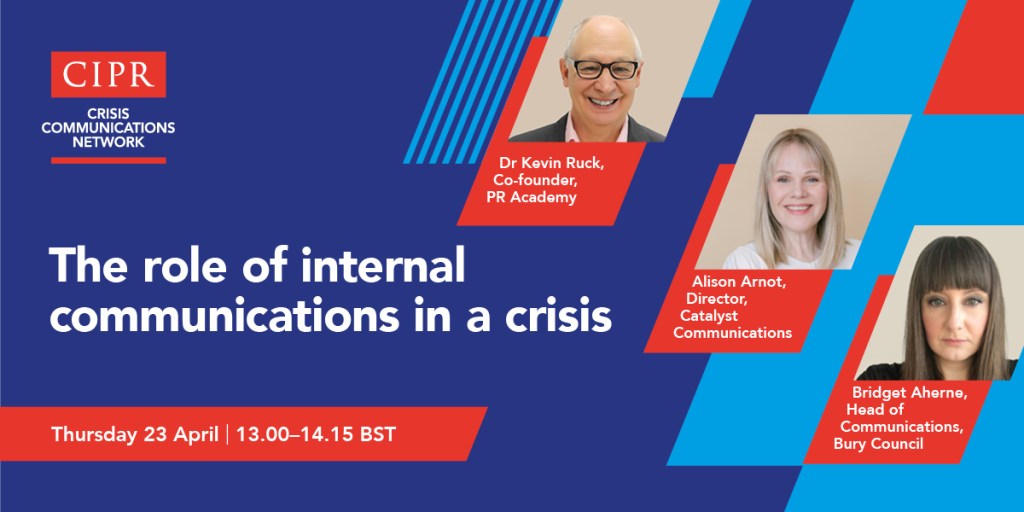
When we think of crisis we tend to think of national newspaper headlines; botched TV interviews; and possibly CEOs hauled before House of Commons or Senate committees. But we need to think too about what is going on back at the organisation. How are the employees reacting to finding their organisation at the heart of the storm?
We know employees are the ultimate brand ambassadors for our organisations. They are also in a crisis amongst the most credible commentators. This webinar looked at how best to communicate with employees in a crisis to look after both their interests and those of the organisation.
We were joined by Alison Arnot CIIC, ChartPR, FCIPR award-winning consultant, trainer, author and speaker with 25+ years’ experience specialising in PR, internal communication, crisis communication, internal crisis communication and change communication. Alison is also the author of ‘Internal Communication in Times of Crisis: How to secure employee trust, support, and advocacy in crisis situations’, which is published by Kogan Page in July 2025 and is available globally.
Alison shared with us her 7S model of internal crisis communication that encourages internal crisis communication professionals to begin with a focus on the basic human needs of survival, support and sensemaking then expand their activity to meet the organisational needs of stabilising, stimulating, sustaining and strengthening as the crisis evolves.
Dr Kevin Ruck is the editor and co-author of ‘Exploring Internal Communication’ and a member of the Editorial Advisory Board of the Journal of Communication Management. Kevin also leads the Internal Communication Research Hub (ICRH) European Affiliate Group and is a Co-Founder of the PR Academy, the largest teaching centre for CIPR qualifications. ‘Exploring Internal Communications’ fifth edition will be available for pre-orders from Routledge on 24th February 2026, with shipping from 17th March 2026. It is also available for pre-orders now from Amazon and other retailers.
Kevin gave us some pointers from the chapter in ‘Exploring Internal Communications’ that covers internal crisis communications and change management. Crisis communications has a lot of similarities with change communications, it is argued in the chapter. Both focus on highly complex situations in which employees experience ambiguity, confusion and stress.
Our panel was be completed by Bridget Aherne ChartPR, Head of Communications at Bury Council. Bridget is a nationally recognised communications, reputation and transformation leader specialising in crisis response, public trust and organisational change across complex public service environments.
Bridget shared with us her experience of managing communications for high-profile and emotionally sensitive incidents, most recently leading internal communications and organisational support for Bury Council following the recent Heaton Park synagogue attack.
This event was chaired by Chris Tucker, Co-Chair of the CIPR Crisis Communications Network.

If you asked CEOs what keeps them awake at night what would they say? Undoubtedly, fear of a cyber-attack would be right up there. Cyber-attacks are increasing, with organisations facing an average of 1,876 attacks per quarter in 2024, a 75% year-over-year increase. In the first half of 2025, the average number of weekly attacks per organization rose to 1,925.
We will probably all have read about the recent Jaguar Land Rover attack (and that of Marks & Spencer) but it is not just private companies that are in the firing line. In June of 2024 more than 3,000 NHS hospital and GP appointments were disrupted by a cyber-attack by a Russian cyber-criminal group, who shared almost 400GB of private information on their darknet site in an attempt to extort money from a company called Synnovis, a pathology testing organisation used by the NHS. This attack highlights that it is not only organisation’s own systems that need protecting but also those of their third-party suppliers.
As crisis communicators we have a role to play in all elements of cyber resilience. Whether that be creating an internal culture alive to such threats right through to having a plan in place to communicate to all stakeholders if the worse were to happen (and remember this may need to work in the absence of traditional online channels of communication which may be out of action in a cyber-attack). As we kicked off 2026 and returned to our in trays, preparing for a cyber-attack was a threat to put right at the top of the pile.
This Webinar sought to help us understand exactly what a cyber-attack is; how they come about; and what the extent of the damage could be – not only to operations, but to reputation and key strategic relationships.
We heard from Rachel Andvig, Director in Risk and Analytics at consultancy, Willis Towers Watson who specialises in cyber-security, and who took us through the type of attacks we are now seeing. We then looked at the challenges of communicating through a cyber-attack with Jim Steven, Head of Crisis & Data Breach Response Services for Experian, the global data and technology company that provides data, analytics, and software to help individuals and businesses manage credit risk and prevent fraud.