2022 Events

A crisis is often said to be the time when PR professionals “earn their stripes” and for some of us, it can be the first time we gain access to the C-suite. The Covid crisis was certainly an example of this dynamic in action. When we are called upon to help a leadership team make the right decisions in a crisis, what principles should we follow? What insights and ethical models are available to help us?
The CIPR Crisis Communications Network brought together a panel of experts on ethical decision making to discuss these matters.
Dr Heather Yaxley FCIPR opened proceedings with a focus on ethical crisis leadership – including insight into problem solving methods relating to the set of ethical resources that she created for CIPR, and which members can access for their CPD. Heather is the founder of Applause Consultancy and has extensive experience in effective and ethical professional practice. As a qualified educator, she has taught at several universities and been involved with CIPR qualifications for over 20 years. Heather co-authored the popular Public Relations Strategic Toolkit, and her new book, Public Affairs Management: A Guide to Professional Practice, will be published by Routledge in 2023.
Eva Maclaine FCIPR talked about CIPR’s ethical code of practice. Eva is a former Chair of CIPR’s Professional Practices Committee. She served on CIPR’s Council for several years and was a CIPR Board Director for four years. In 2021 she was invited to join the Global Alliance’s European Regional Council. Eva is an occasional guest lecturer and a contributing author on international communications to An Introduction to Public Relations (Pearson May 2013)and CIPR’s Platinum (2018). She has been awarded the CIPR Sir Stephen Tallents medal and the PRO PR Globe Award.
Rachel Roberts, the Founder of Spottydog Communications and is this year’s CIPR president, presented some real-life ethical dilemmas faced by individuals and companies during the recent Covid pandemic.
The session was chaired by Katherine Sykes of the CIPR Crisis Communications Network.

When dealing with a crisis we are always told to put those who have been impacted at the heart of our response. But how well geared up are organisations to reach thousands or millions of customers without prior warning?
Jim Steven, Head of Crisis and Data Breach Response at Experian Consumer Services
Jim shared his insights into how to prepare for, and roll-out, customer communications during a crisis. To ensure those impacted by a crisis are supported, this includes putting in place a comprehensive consumer response plan that will address everything from customer notification call centre support to providing credit and identity monitoring services.
Kimberley Rushton
Kimberley was working in the communications team for an NHS Trust when on Friday, 12 May 2017, a global cyber-attack known as WannaCry hit more than 200,000 computers across 100 countries. In England, the NHS was affected particularly badly: over 80 hospitals were either impacted directly by the virus or because they shut down their systems to avoid being infected. Kimberley’s Trust swiftly shut down computer systems and then declared a major incident. Since all its computer systems were offline, there was no way to easily access patient information and the Trust’s Crisis Management Team (CMT) decided to cancel all planned, non-urgent appointments and operations in the interest of patient safety. Kimberley talked us through how the Trust and the communications team dealt with this incredible challenge, working to keep patients and employees updated on the situation over the days that followed the attack.
Nic Daley, Co-Head, UK Issues and Crisis at FleishmanHillard
Jim and Kimberley was joined by Nic, who provided insight into how PR responses to crisis events have evolved especially around cyber incidents.
This event was chaired by Chris Tucker of the CIPR Crisis Communications Network.

As the Network grew, we wanted to double down on our aim of creating an open and inclusive forum firmly focused on members’ most pressing crisis communication questions and challenges. With that in mind, we held our second Open House in October 2022.
Hosted by our Co-Chairs Katherine Sykes and Chris Tucker – as well as our Special Advisor, Rod Cartwright – we intentionally avoided a fixed agenda, as the session is designed to be member-led.

Among the many changes brought about by the COVID-19 pandemic, the stampede to high quality virtual content and engaging online events stood out as one of those most likely to remain.
The CIPR Crisis Communications Network – launched in September 2021 – reflected that trend, with a series of excellent events and the creation of a new Network-specific blog.
However, the Network was about more than simply events and content. As an open and inclusive forum, whose mission it is to champion excellence in crisis communications, our aim is to create a vibrant community of shared interests.
With that in mind, we decided to hold regular ‘Crisis Open House’ sessions – open to all CIPR members in the UK and internationally – with an interest and involvement in crisis communication. Hosted by the Network’s Co-Chairs Katherine Sykes and Chris Tucker – as well as the Network’s Special Advisor, Rod Cartwright – the 45-minute sessions would allow members to explore with Katherine, Chris and Rod:
1. The major crisis communication stories of the previous month
2. Emerging trends in issues management and crisis communication
3. Live (anonymised) issues raised by attendees
With no fixed agenda, the ‘Crisis Open House’ sessions are specifically designed to be member-led, balancing our set-piece events with a regular open forum for community discussion and engagement.
For our first ‘Open House’ session, we looked at how many of the global risks identified for 2022 manifested themselves.

Even before the Russian-Ukraine war cyber attacks topped the list of crises most feared by management teams around the world, and most likely to happen. Such attacks are complex, highly technical, affect multiple stakeholders and can ultimately bring an organisation to its knees.
In conjunction with Polpeo, CIPR’s Crisis Communications Network we hosted a cyber attack crisis simulation. Polpeo’s unique simulation platform has been designed to simulate a crisis breaking and spreading over social networks, blogs, microblogs, forums, local community groups, review sites, petitions, messenger and chat apps, email and new sites. Attendees learnt how to communicate effectively in a cyber crisis across multiple channels. They were asked to respond on different channels as well as prepare a crisis strategy and messages, document their response and deal with incoming queries from the public, media and other stakeholders. They also learnt how to avoid inflaming a situation and how different strategies and responses impact the outcome of a crisis on a company’s reputation.
The session was co- Chaired by Kate Hartley, Co-Founder of Polpeo and Chris Tucker, Chair of the CIPR Crisis Communications Network.

How many times do we see a crisis unfold and find ourselves asking the simple, human question: “why don’t they just say sorry?”
For crisis communicators, that is not the only question: What are the legal implications (if any) of saying sorry? Does an apology even matter if the crisis may result in civil or even criminal proceedings? What is the right balance between legal and reputational liability?
All these questions and more were tackled in this provocative webinar, which brought together experts from across crisis communication and the law, Emma Woollcott, Head of Reputation Protection and Crisis Management at Mishcon de Reya, Kate Betts, a former journalist, media trainer and expert in crisis communications and Mary Whenman, Director of Communications at the British Business Bank.
The session was chaired by Rod Cartwright, Special Advisor to the CIPR’s Crisis Communications Network.
This event was held in memory of our friend and colleague, Leigh Richards, who died on 26 February 2022.
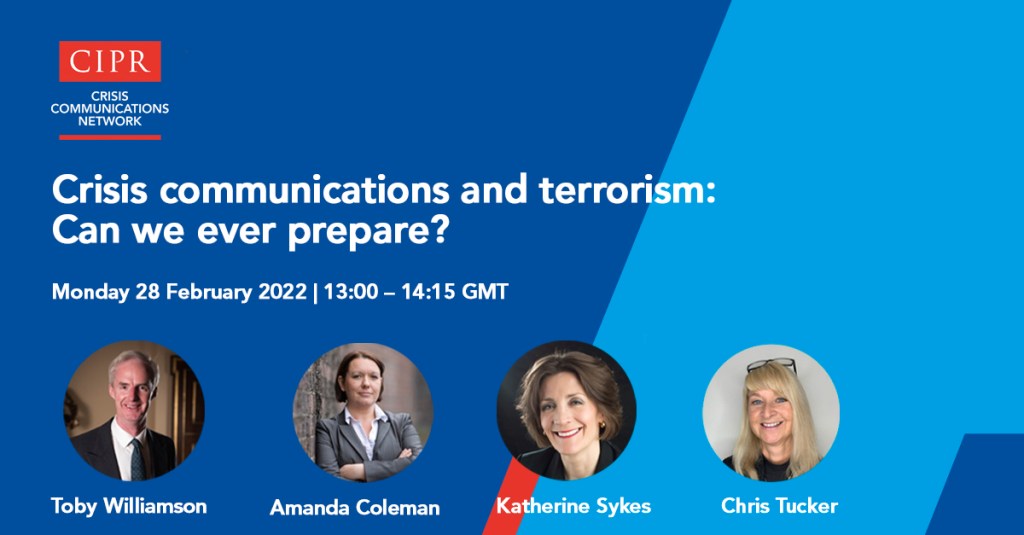
At any time, decisions about what to communicate, when and to whom in a crisis are difficult and challenging. In a nightmare scenario, a terrorist attack could occur without warning and affect any one of us, from the organisers of venues to the man on the street.
What is the role of a PR professional when every second could literally mean the difference between life and death? What, if anything, can PR professionals do to manage the message in a situation where, for all the right reasons, the emergency services are much more in control than we are?
What is it like to work under such pressure and how do we select our priorities? How should we prepare for such catastrophe and, if the time comes, to minimise panic whilst also providing the best possible communications in the broadest sense? Our guests shared their insights.
As Clerk of Fishmongers’ Hall, London Bridge, Commodore Toby Williamson led the emergency response when one of the attendees of a prisoners’ rehabilitation conference held in the Hall mounted a terrorist attack in 2019. Three people, including the terrorist, Usman Khan, died and several others were injured. Williamson, not a PR professional but trained in communications during a distinguished career in the Royal Navy, led the Hall’s communications during and immediately after the incident, working with those inside the Hall, the victims, the emergency services and the world’s media.
Amanda Coleman (@amandacomms) is a crisis communications consultant and a fellow of both the CIPR and the PRCA. She was previously the Head of Corporate Communications for the Greater Manchester Police and managed many significant crises including the Manchester Arena terrorist attack in 2017. Amanda will provide a unique insight into what to expect from how the police operate in such incidents and what we can all do to prepare ourselves and our organisations for such an event.
This event was chaired by Chris Tucker and Katherine Sykes.