2025 Events
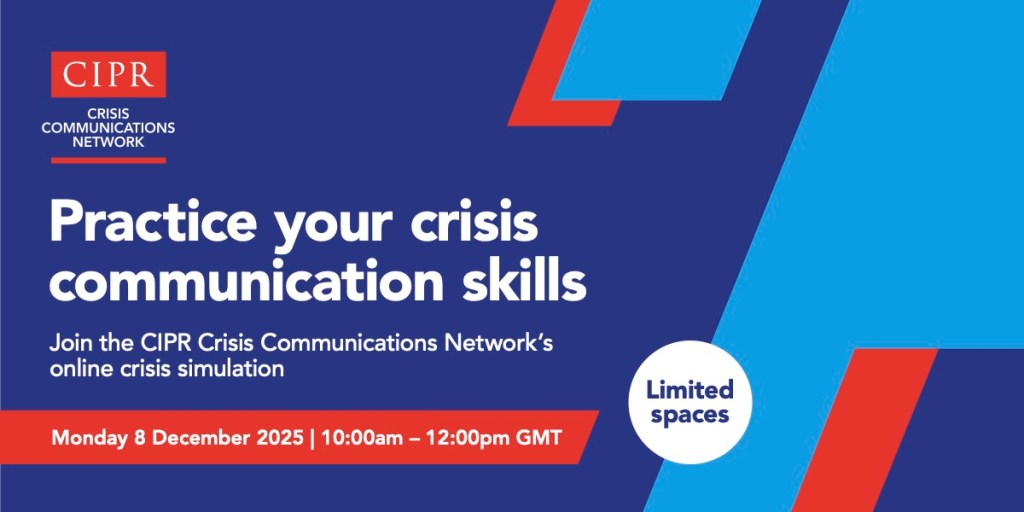
Testing your crisis communication plans and capabilities with a crisis simulation is a crucial building block of building your own and your organisation’s resilience. With that in mind the CIPR Crisis Communications Network was delighted to host a free crisis simulation on 8 December 2025. Only 50 spaces were available and allocated on first-come first-served basis.
The crisis simulation was run on the proprietary software of Polpeo, the leading crisis simulator. Polpeo’s platform has been designed to simulate a crisis breaking and spreading over mainstream media, social media, blogs, microblogs, forums, local community groups, review sites, petitions, messenger and chat apps, email and new sites. Attendees were put in teams and asked to respond on different channels to an unfolding crisis, as well as prepare a crisis strategy and messages, document their response and deal with incoming queries from the public, media, and other stakeholders.
Attendees learnt how to communicate effectively in a crisis across multiple channels. They learnt how to avoid inflaming a situation and how different strategies and responses impact the outcome of a crisis on a company’s reputation. The type of crisis was not revealed until the simulation began on the day.
The session began with a short overview of the key principles of crisis communication led by Kate Hartley, co-founder of Polpeo and author of “Communicate in a Crisis”. After a few minutes instructing the attendees on how to use the simulation software, the simulation began and lasted for one hour and 15 minutes. Kate then participated in a wash up discussion and took questions on the simulation and how attendees responded. The entire session lasted about two hours and was chaired by Chris Tucker, Co-Chair of the CIPR Crisis Communications Network.

Earlier this year, the Network’s Special Advisor, Rod Cartwright, published the 2025 edition of his award-winning report ‘Reputation, risk and resilience; where are we now and what happens next?’.
Expanding on previous editions, this year’s report summarised and analysed eleven major global reports on those interlocking topics, synthesising 834 pages of original source material.
Drawing on that analysis, Rod drew out ten red-thread themes running through those publications, three core risk dynamics underpinning those themes and ten critical questions leaders should address in managing their implications.
At its core, sits a bold, practical provocation – that we need to fundamentally rethink crisis, reimagine risk and re-engineer preparedness around the idea of ‘critical human infrastructure’. Put simply, all the technical systems, technological processes and pre-prepared materials are of little value unless they are culturally embedded in the organisation and its people.
For our penultimate event of 2025 (the last being an exciting crisis simulation on 8th December!), we assembled a big-hitting panel of experts, who explored with Rod how we could better capitalise on the opportunity to deploy crisis preparedness and resilience-building as sources of hugely positive tangible value and material opportunity.
The panel was made up of:
- Katie Barnes, Executive Director of the National Preparedness Commission,
- Joe Palasz, Head of Crisis Communication Strategy at the Cabinet Office,
- Mary Whenman, Managing Director, Communications and Marketing at British Business Bank.
Given the roles held by some of the panellists, this session was not recorded as we normally do for our events.

CIPR Crisis Communications Network members and Committee gathered for our popular in-person meet-ups. The Winter Drinks took place at The Riverside in Vauxhall.
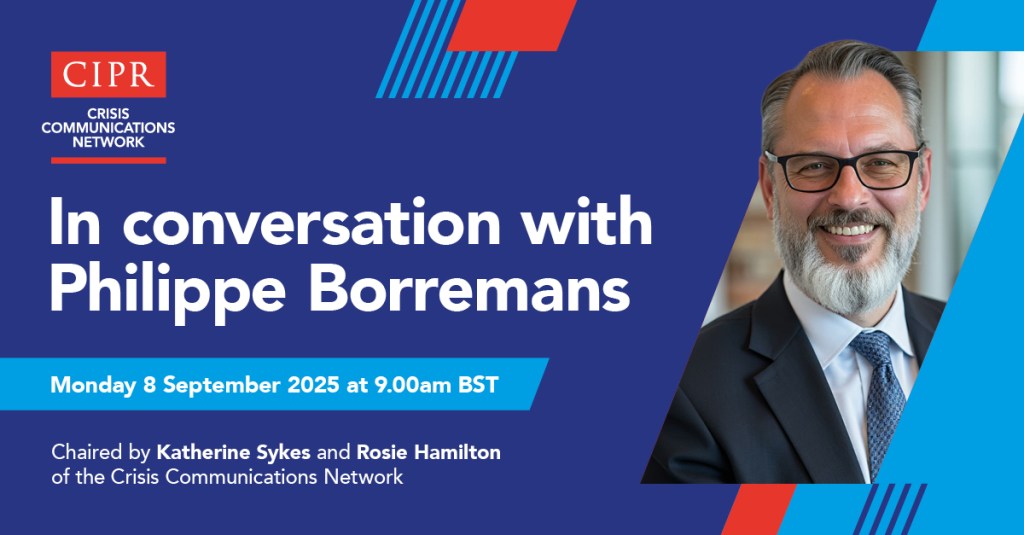
Chaired by Katherine Sykes and Rosie Hamilton of the Crisis Communication Network, this event explored what differentiates risk and emergency communications from crisis communications and how AI is reshaping the landscape for communications professionals.
With over two decades of experience, Philippe Borremans has established himself as one of the world’s leading experts in emergency risk and crisis communications. His areas of specialism include epidemic preparedness, strategic communication planning and crisis simulation exercises and training.
Borremans has held several leadership positions including President of the International Public Relations Association (IPRA 2021), Vice President of the International Association of Risk and Crisis Communication (IARCC), and board member of the European Association of Communication Directors
As an independent consultant he works on strategic communication projects with prestigious organizations such as the World Health Organization and the European Union.
Borremans has been exploring how artificial intelligence can be leveraged in crisis communication scenarios since the early days of AI adoption. He publishes a weekly ‘Wag The Dog’ newsletter and podcast covering the latest trends in crisis, risk, and emergency communication, with a focus on technology and AI. His book ‘Mastering Crisis Communication with ChatGPT: A Practical Guide’ —published in early 2023 – was among the first to examine the role of AI in crisis communication strategy and execution, establishing him as an early thought leader in this emerging field.
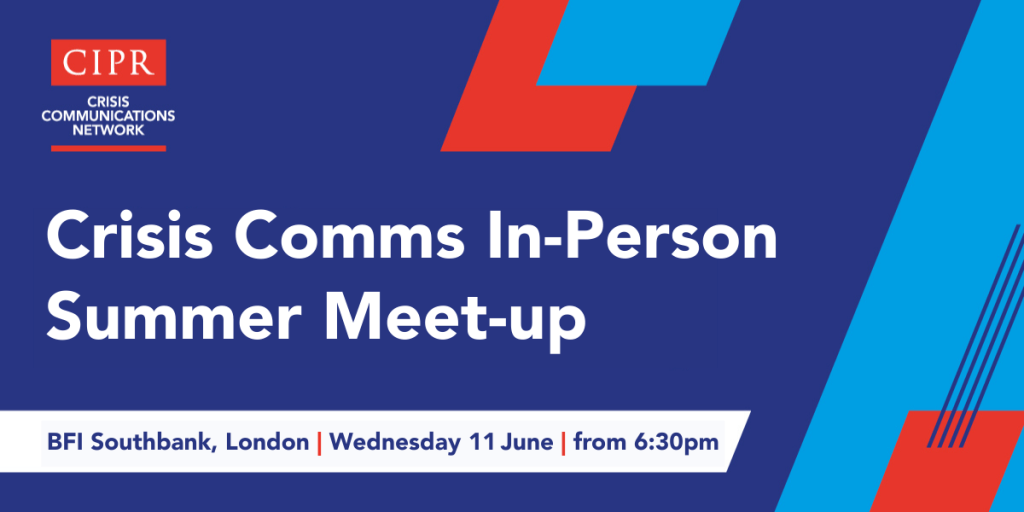
It was an evening of connection and conversation at the Crisis Comms In-Person Summer Meet-up.
A relaxed opportunity to catch up, share insights and enjoy a drink with others working in the space. There was no agenda, no formalities, just friendly networking and easy conversation to welcome the summer.
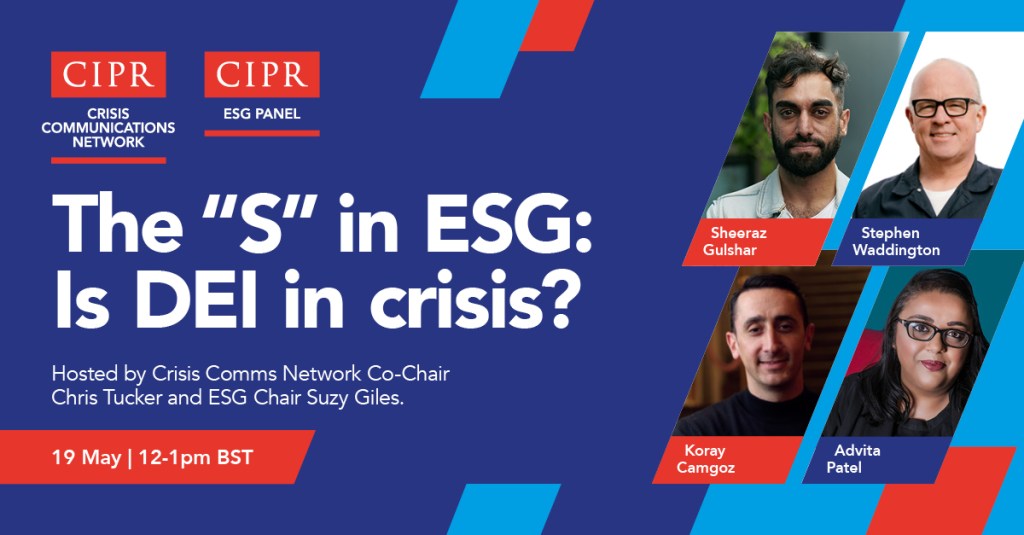
In today’s volatile landscape, Diversity, Equity, and Inclusion (DEI) initiatives have become central to discussions on social responsibility within Environmental, Social, and Governance (ESG) frameworks.
However, recent global developments have intensified debates surrounding DEI policies – with some organisations under pressure to defend or dismantle the very strategies they once championed.
Against this backdrop, the “S” in ESG is increasingly seen as both a reputational asset and a risk. This session explored how communications professionals can support their organisations through this complexity – helping leadership navigate shifting expectations, social risk, and potential backlash.
Hosted by the CIPR Crisis Communications Network and the CIPR ESG Network, the event was chaired by Chris Tucker, Co-Chair of the Crisis Communications Network, and Suzy Giles, Chair of the ESG Network.
Our speakers were:
- Koray Camgöz, CEO of the Taylor Bennett Foundation, which champions diverse talent in PR and communications.
- Advita Patel, founder of CommsRebel and President of the CIPR, helping leaders create inclusive cultures through strategic comms.
- Stephen Waddington, advisor at Wadds Inc. and co-founder of Socially Mobile, supporting underrepresented PR professionals.
- Sheeraz Gulsher, Co-Founder of People Like Us, a not-for-profit supporting diverse talent in UK comms and marketing.
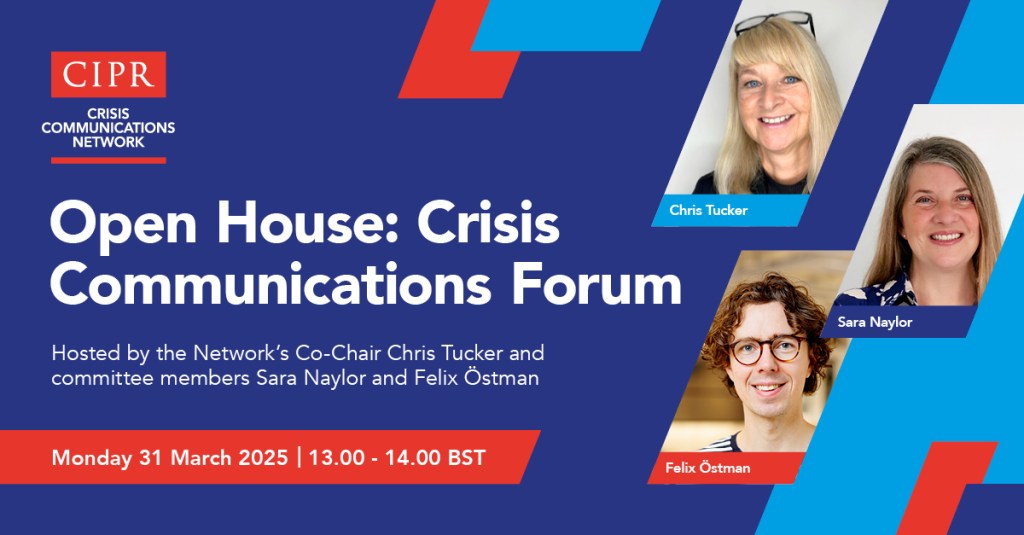
This Open House forum was hosted by the Network’s Co-Chair Chris Tucker and committee members Sara Naylor and Felix Östman.
Much of the discussion centred on the Heathrow fire crisis. Participants also shared expert advice on other global crisis and experiences from their practice.
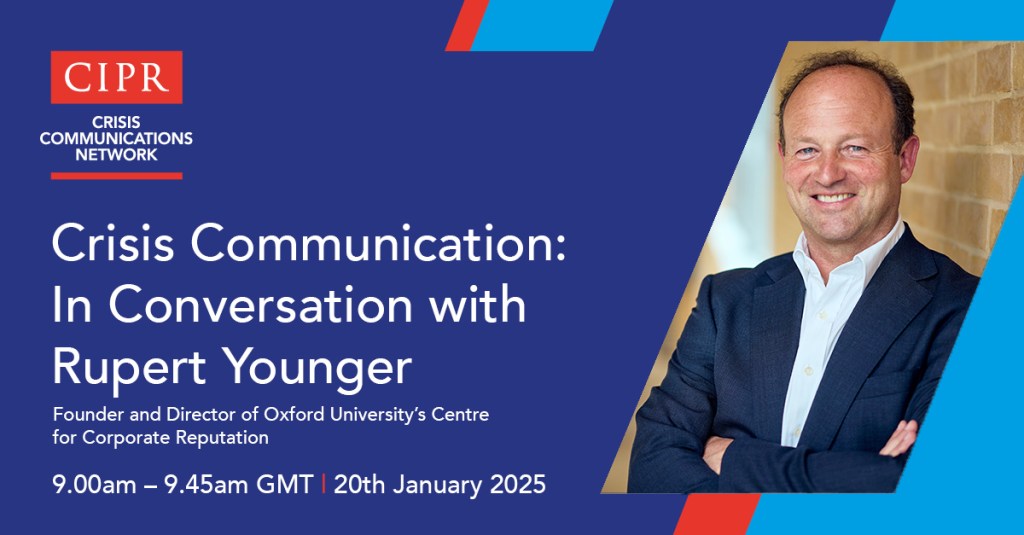
For our first event of 2025, we had a conversation with Rupert Younger, the founder and director of Oxford University’s Centre for Corporate Reputation.
2025 promises to be no less momentous or potentially tumultuous than 2024, and our opening event of the year took place on the morning of President-Elect Donald Trump’s second inauguration.
Rupert co-founded leading global strategic communications agency Finsbury (now FGS Global) with Roland Rudd in 1994, and is co-author of The Reputation Game and The Activist Manifesto. His third book, Forked Tongues, will be published in 2025. He is also the Founder and Academic Director of Oxford’s internationally-renowned Corporate Affairs Academy.
Established in 2008, the Oxford University Centre for Corporate Reputation is home to social evaluations research at Oxford, exploring how organisations manage social evaluations such as reputation, status, celebrity, legitimacy, stigma and trust. Drawing on Rupert’s long and esteemed career as a corporate advisor, writer and educationalist, we will explore his personal experience of advising on issues, crisis, risk and resilience.
We looked at how his work approaches the question of how businesses orient themselves to meet new and emerging societal issues – or ‘Alignment Challenges’ as the Centre calls them – including stigma, crisis and governance.
We also explored Rupert’s and his team’s research into ‘Practice Challenges’ – “business activities that pose both opportunities and threats for organisations and how they are perceived by key stakeholders” – including AI, activists and activism, fake news and political engagement.