2023 Events

During 2023, the culture of an organisation come under the spotlight like never before. Numerous crises, such as those impacting Westminster, McDonalds, the Metropolitan Police, CBI, ITV’s This Morning and the BBC, have all been attributed to “toxic culture.” But what do we mean by this term? How can a sub-optimal corporate culture be dealt with before it becomes a crisis? And what responsibility does the board have in identifying the risks and rewards posed by people and culture? In its eighth event of the year, the CIPR Crisis Communications Network brought together a panel of experts to give their insights into the links and dynamic between corporate culture, politics, workplace engagement and crisis.
David Ferrabee is the Managing Director of Change, Culture and Engagement at Teneo. He advises clients on how to measure and manage their organisational cultures. In his experience, culture can be the key to competitive advantage. However, most organisations pay too little attention to it, or only look seriously at it when it goes wrong. David has 30 years of experience working with leading companies around the world. He is a native Montrealer, based in London, but educated in France and Africa as well.
Fiona Hathorn is the CEO and Founder of Women on Boards, a purpose-led business launched in the UK in 2012 that works to increase diversity in executive and non-executive leadership. From an initial focus on supporting women into non-exec and board roles, WOB has evolved to work extensively with corporate partners on building inclusive cultures which are gender neutral and fully intersectional. WOB’s recent research Hidden Talent 2023 reveals the importance that an organisation’s people and culture have on its reputation and prosperity.
Dr Hannah White OBE is the Director of the Institute for Government and author of Held in Contempt: What’s Wrong with the House of Commons?. She has extensive knowledge of Whitehall and Westminster, based on over a decade’s experience of Parliament and the civil service.
This session will undoubtedly be one of our most interesting events to date and will be chaired by Chris Tucker and Katherine Sykes, Co-Chairs of the CIPR Crisis Communications Network.

Your people are your greatest asset, but if you employ people, you also have insider risk. The rising cost of living, organisational distrust and increasing levels of online organised crime are all making the incidence of insider events like leaks, sabotage or even staff-based violence, more commonplace. And yet 60% of organisations do not have a plan to manage insider risk appropriately.
The 7th event of the CIPR Crisis Communications Network’s 2023 event series brought together communication and security specialists, to explore how organisations can build their resilience by adopting a truly integrated approach to managing insider risk. The session was also informed by a new guidance report from the National Protective Security Authority (shared with participants after the event), examining the crucial role of communications in preparing for, managing and recovering from insider events.
The term ‘Insider’ does not suggest ill-intent. In fact, NPSA defines an insider as: “any person, who has, or previously had, authorised access to or knowledge of the organisation’s resources, including personnel, facilities, information, equipment, networks, and systems”. Whether insider events are intentional or unintentional, they should be identified within risk assessments and managed accordingly.
Insider events are distinct from other crises, and can strike at the heart of how an organisation operates and manages it people. They can tear teams apart, have a lasting impact on culture and destroy trust from within the organisation. The good news is that an engaged workforce can help reduce the likelihood and impact of an insider event.
Chaired by Rod Cartwright, the Network’s Special Advisor and Network Co-Chair, Katherine Sykes, the panel was made up of:
- HM Government Security Expert, National Protective Security Authority
- Fiona Walters, Regional CEO, UK and Ireland, G4S
- Jenni Field, Founder and Director, Redefining Communications and Past President, CIPR
They explored how insider events require a different approach from generic crisis communication, discussing how breaking down organisational siloes, working with cross-functional teams to create a safe and open culture, great leadership and regular communication can help organisations prevent, manage and recover from insider events.
It was a delight to collaborate with the CIPR Inside group on this exciting event, reflecting the critical role of internal communication, employee engagement and organisational culture in this ever-growing area of corporate risk.

Open House returned on Wednesday, September 20th at 1.00pm BST. As usual, we opened the floor to our members and discussed crisis topics that was of interest to them.
At Open House we launched our first publication – How to Write a Crisis Communications Plan. This skills guide covers eight steps to writing a crisis communications plan, some general dos and don’ts, and concludes with a useful checklist for use in a crisis. It also includes recommendations for further reading plus links to the excellent CIPR Crisis Communications training and qualifications that are available.

If there is one thing that reputational crises consistently teach us, it is that there’s actually no such thing as a ‘PR crisis’.
In reality, so-called PR crises are invariably the result of some combination of operational, structural, leadership, governance, decision-making and cultural factors – many of which sit well beyond the communications function. And yet, crisis communicators all too often risk conducting crisis preparedness in splendid isolation from the other corporate functions central to these dynamics – be it Legal, Marketing, Human Resources, Operations, Strategy or Risk.
Our fourth event in 2023 brought together crisis communications and resilience specialists to explore how organisations can build their resilience by adopting a truly integrated approach to crisis preparedness.
Chaired by Rod Cartwright, the Network’s Special Advisor and Sara Naylor, Network Steering Committee member, the panel incorporated:
- Charlie McLean-Bristol, Founder and Director of Plan B Consulting
- Elmarie Marais, CEO of GoCrisis
- Rina Singh, host of the RESILIENCEPOD podcast.
They explored how best to integrate fully communications and operational factors, including systematic risk identification and prioritisation, scenario planning and stress-testing.
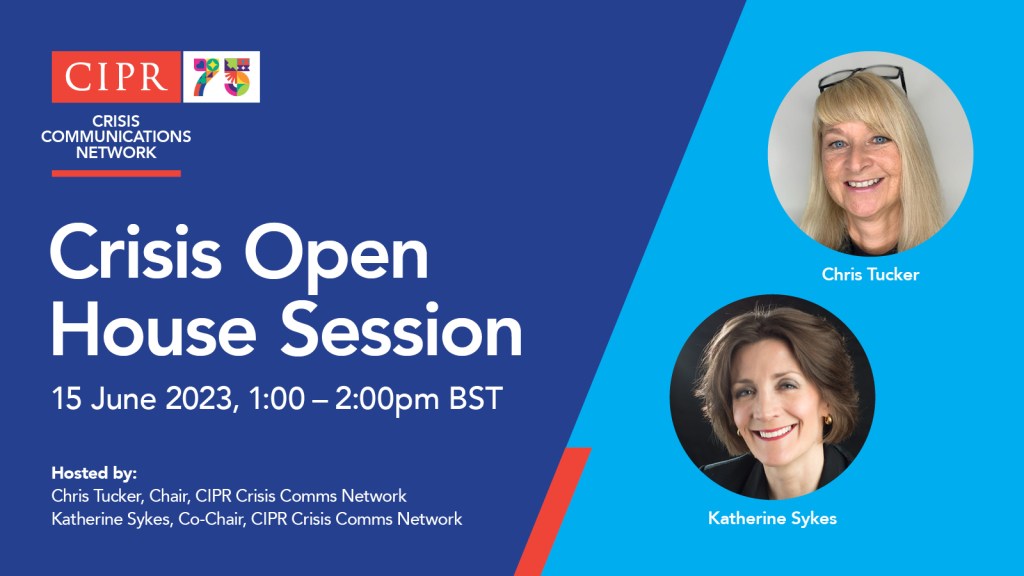
As we neared 500 members, we were as keen as ever to give our members a chance to get involved and use the Network as a forum to exchange ideas and share challenges.
This session was hosted by the Network’s Co-Chairs Katherine Sykes and Chris Tucker.

Unless you were living under a stone, the end of 2022 and start of 2023 probably involved a relentless social media carpet bombing of ChatGPT experiments and generative AI discussions.
As 2023 saw the apparent coming-of-age of generative AI – somehow crystalised by OpenAI’s launch of ChatGPT – what did this quantum leap in commstech mean for issues management and crisis communications.
Is this a threat, an opportunity or both? How do we balance discussions about tactical implementation and strategic adaptation? What are our ethical and moral responsibilities as leaders in deploying generative AI? And what are the implications for existing practice models – whether agency or in-house.
These are just some of the crucial debates we discussed with a panel of crisis communication and technology experts:
1. Paul Quigley, CEO of NewsWhip
2. Ed O’Brien, Head of Issues & Media Management at KPMG
3. Philippe Borremans, Vice-President of the International Association of Risk and Crisis Communication and author of the recent ebook “Mastering Crisis Communication with ChatGPT: A Practical Guide”
4. Varun Puri, Co-founder, Yoodli.
The session was co-chaired by the Network’s Special Advisor and Visiting Fellow to Cardiff University’s Centre for Journalism and Public Communication, Rod Cartwright, and Chris Tucker, the Network’s Co-Chair.

Any good crisis communicator will tell you that their job is to safeguard and enhance their organisation’s reputation, right? Well, to an extent. Because even if reputational protection is your north star, getting there hinges fundamentally on one critical factor in every crisis – human beings and human outcomes.
For our second event of the year, we assembled a panel of specialists in caregiving, psychology and human performance to explore the critical importance of safeguarding your team’s human wellbeing during a crisis.
Intan Darlina Muhammad, former Caregiver Manager at Malaysia Airlines, will explore next-of-kin caregiving and team wellbeing under intense pressure. Darlina led Malaysia Airlines’ teams of hundreds of caregivers in Beijing, Amsterdam and Kota Kinabalu, following the disappearance of flight MH370 in March 2014 and the tragic shooting down of flight MH17, just four months later.
She was joined by Nick Propper, long-standing PR agency leader and CEO of Impact Human Performance – an agency which helps organisations to replace uncertainty with purpose, fatigue with energy and fear with resilience. Nick examined how best to ensure war room and dispersed colleagues manage their stress and energy during a protracted crisis.
Finally, Rob Stewart, a business psychologist specialising in leadership and organisational culture, explored how group identity, psychological safety and a growth mindset are the ultimate triad for ensuring the wellbeing of people during a crisis.
The session was co-chaired by the Network’s Special Advisor, Rod Cartwright (who worked with Darlina on MH370) and steering committee member, Sara Naylor, Founder of Ravenhill Media.

The past decade has been characterised by an ever-greater sense of flux and uncertainty, with every year heralding in events more unsettling and confusing than the last.
An issues-rich and risk-laden environment is, of course, the meat and bread of the crisis communications professional. However, with that opportunity comes a growing expectation for crisis communicators to sit further upstream, providing guidance and counsel directly impacting corporate outcomes. And yet, as crisis and risk communications experts seek to rise to that challenge and capitalise on those opportunities, there remains one conversation almost entirely missing – that between practice and academia.
As the CIPR Crisis Communications Network continues to deliver on its mission to champion excellence in crisis communications, we brought together a panel of experts from both sides of the (current) divide to tackle this unnecessary separation of ‘church and state’.
The panel discussed how to bridge these two important worlds, so that each community can better inform and benefit from the other, together with the challenges and potential obstacles to doing so.
The session was chaired by Rod Cartwright, Special Advisor to the Network and Visiting Fellow to Cardiff University’s renowned Centre for Journalism and Public Communication, and Chris Tucker, the Network’s Co-Chair. The panel consisted of:
- James Barbour, Vice President, Global Public Relations and Strategic Projects, Schneider Electric.
- Audra Diers-Lawson, Førsteamanuensis (Associate Professor), Kristiania University College and Chair, European Communication Research and Education Association (ECREA)/ECREA Crisis Communications Committee.
- Jonathan Hemus, Managing Director, Insignia and Chair, Aston University Crisis Centre.