
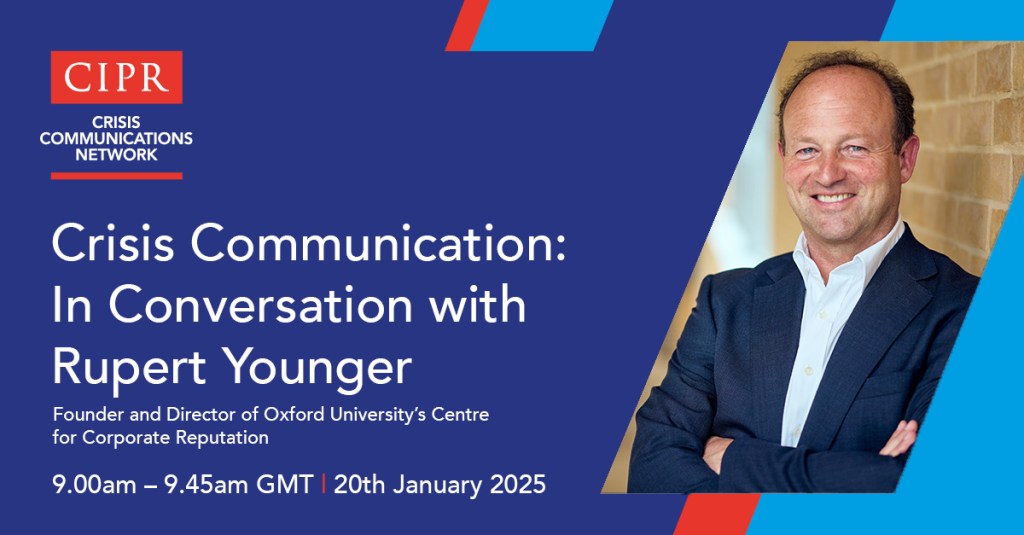
The Crisis Comms Network kicked off its 2025 programme on Monday, January 20th with a return to its breakfast timed event, In Conversation With… We had almost 120 people tune in to hear from a reputation management master with more than 30 years’ experience of operating at the top of his profession. We came away buzzing with ideas and with an introduction to a concept new to many of us that helps explain why some organisations manage to weather the storm of crisis whilst others sink below the waves.
Our guest for the event was Rupert Younger, founder and director of Oxford University’s Centre for Corporate Reputation. Rupert co-founded leading global strategic communications agency Finsbury (now FGS Global) with Roland Rudd in 1994, and is co-author of The Reputation Game and The Activist Manifesto. His third book, Forked Tongues, will be published in 2025. He is also the Founder and Academic Director of Oxford’s internationally-renowned Corporate Affairs Academy.
Established in 2008, the Oxford University Centre for Corporate Reputation is home to social evaluations research at Oxford, exploring how organisations manage social evaluations such as reputation, status, celebrity, legitimacy, stigma and trust.
It was interesting to hear Rupert kick off by essentially reminding us PR folk of our tendency towards “imposter syndrome.” The comms profession has, as Rupert said, a lot of “super intuitive, super smart, super quick” people working in it but we feel we lack the sort of academic rigour to under-pin the advice we give. Rupert’s mission behind his founding of the corporate reputation centre at Oxford was to close that gap by providing leading edge research and concepts that we can work with in the real world.
Rupert has concentrated his work not just on reputation and trust but also on what he calls “social evaluations” which is broader than reputation and looks at how perceptions are formed and can be influenced. His work looks at legitimacy, how do you become renowned for what you do, status and who has it, and stigma and celebrity. And celebrity is no longer confined to the world of entertainment if we think particularly of the tech moguls who flanked the new US President Trump at his inauguration.
This work on social evaluations has important lessons for crisis communicators focusing as it does on what Rupert called “perceptions of capability and perceptions of character.”
Organisations have a capability reputation that is determined by their ability to do well what they exist to do, for example, a car company making excellent cars, but they also have a character… “how you show up” as determined by organisational culture and organisational character. Looking at organisations that experience crises through these two lenses of capability and character helps us understand the trajectory some crises travel through.
The capability aspect of reputation is very static, for example, BP is still drilling for oil, VW is still making cars and Boeing still building planes. They have very long-standing records of technical capabilities built up over many years. By contrast character reputations are very volatile. That character reputation is very often symbolised by the CEO and Rupert gave us the examples of Alison Rose at NatWest and Bernard Looney at BP who paid with their jobs for falling short on that character aspect of reputation.
Rupert went on to explain these different aspects of reputation matter to different stakeholders. Capability is key to customers who foremost want products and services to deliver. This helps us to explain why customers stick with organisations that appear to be in some sort of reputational crisis: Ryanair and Primark sprang to mind. Character by contrast matters to what Rupert called “counterparties” i.e. investors, employees, regulators, suppliers. Investors in particular are interested in quantifying risk in an organisation, and they see character issues as making that much more problematic and harder to predict.
Looking ahead for 2025 and commenting on our very own Rod Cartwright’s Risk, Reputation and Resilience report Rupert said the risks highlighted mean this is a time for what he called “extraordinary leadership skills” which means the importance of “empathy and listening skills.”
The 80s was all about the strong leaders – Jack Welch, CEO of General Electric, being the key example. There have been many phases and leadership concepts since.
But today we are facing what Rupert calls “ignorant certainty” or people with very strong beliefs who are not willing to hear what the other side has to say. We need leaders who can actually listen and put a premium on the need understand what the other side of the argument may be and find a way through where there are obvious differences.
But this need to listen also applies to corporate affairs professionals. “Corporate affairs leaders need to be better listeners, and they need to be bold enough to listen where others don’t.” Questions around is our profession diverse enough to meet this challenge will be examined at our event on May 19th when we team up with the CIPR’s ESG Panel.
According to Rupert this is also a time for organisations to reflect on their purpose. For Rupert purpose is a very powerful leadership tool and an organisational principle. Purpose should sit alongside those listening and empathy skills to help organisations make the right decisions about what they should and shouldn’t do. We all know so many crises happen when the wrong decisions are taken in terms of stakeholders have the right to expect.
However, once all that data and intel has been taken in there is a role for us PR and crisis comms professionals in terms of what is being called our “superpower.” This is our ability to sense-make, to join all those dots together, to draw connections where connections are not obvious, to develop shared insights, and thirdly “to build inter-connected pathways to solutions.”
The final important theme Rupert pointed to where we clearly have a role is that of corporate culture. “If you have a bad culture, it exposes you to extraordinary risks… increasingly communications professionals and corporate affairs leaders are now taking a senior role on culture,” said Rupert. For Rupert the risks inherent in corporate culture is what is keeping many corporate affairs leaders awake at night. It is at the heart of the character aspect of reputation Rupert spoke of throughout the session. It is what costs jobs: CEO and Corporate Affairs Leaders both.
Author: Chris Tucker, Co-Chair, CIPR Crisis Communications Network
Discover more from
Subscribe to get the latest posts sent to your email.