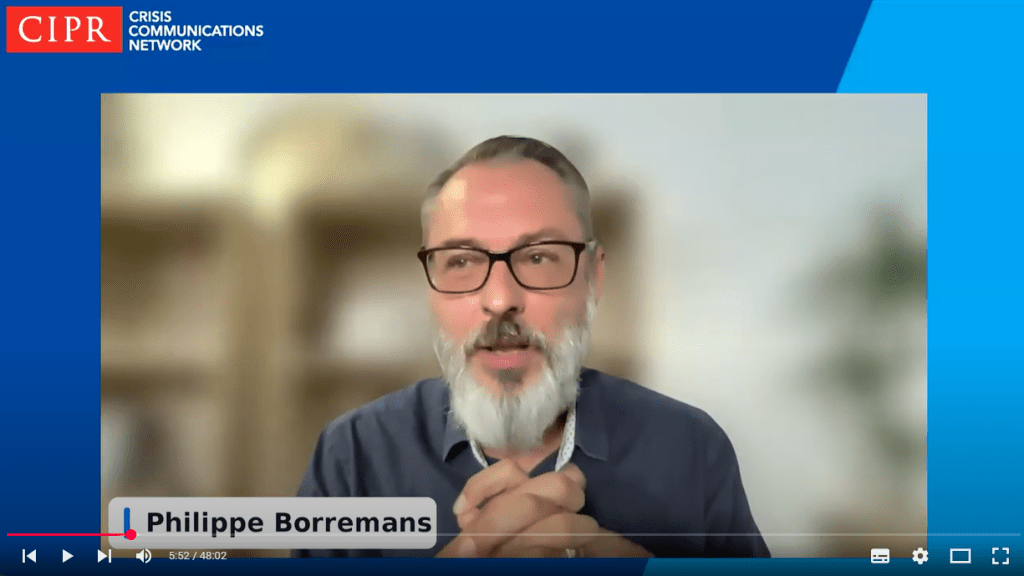
The Crisis Communication Network is truly blessed to enjoy the support of some of the world’s foremost experts on crisis communications. On 8 September, Rosie Hamilton and I were absolutely delighted to host a conversation with the wonderful Philippe Borremans.
Philippe’s expertise covers risk, crisis and emergency communications, pandemic and epidemic preparedness, strategic communication planning and crisis simulation exercises and training. It also covers artificial intelligence (AI), especially in the context of crisis and emergency communication scenarios.
Given the depth and breadth of Philippe’s experience, we addressed the conversation in two parts: firstly, what differentiates risk and emergency communications from crisis communications and why it matters and secondly how AI is reshaping the landscape for communications professionals.
What is risk, crisis and emergency communication?
The Covid pandemic provided a (long overdue) wake-up call to the importance of crisis communication but since 2020, the world has become even more complicated, polarised and uneasy, meaning that it is increasingly important for professional communicators to have emergency communication skills in their toolbox too.
So what is the distinction between risk, crisis and emergency communication and what difference does it make to practitioners? According to Philippe, understanding the distinction not only provides insights into the different rhythms and objectives of a situation, but also affects how we understand and respond from a communications perspective too.
- Risk communication contains an educational aspect: It helps people to understand risk and to prepare for crisis whilst there is no current crisis.
- Crisis communication occurs when a crisis occurs and there is an immediate need to respond.
- Emergency communication takes place during a crisis/disaster/emergency. It is more directive, tells people what to do in the situation and requires an active reaction (eg ‘evacuate your home now’).
A useful analogy might involve a smoker visiting their doctor. In stage one, the doctor might tell the smoker that they are involved in a risky activity and advise them how to quit (risk communication). In stage two, the doctor tells the patient that they have cancer and sets out what will happen next (crisis communication). Stage three involves communication around the operating table (emergency communication).
Of course, these distinctions may merge in some circumstances and for some organisations. If you work in an organisation that may need to cover both corporate and emergency communications (such as a local authority), Philippe’s advice is to draw a clear line between corporate communications (which affect the reputation and effectiveness of the organisation) on the one hand and emergency communications (which affect people directly) on the other as they operate on different dynamics. People should always be the priority: if there is a choice between managing risk to human life or managing an organisation’s reputation, always choose the former. Reputation will follow.
Audiences first
Philippe believes that, in any communication, audiences – not stakeholders or brand – must always come first. If you start your communication plans here, you can then build back on a strategic and tactical level. Notwithstanding all our careful planning and preparation, we all know that crisis plans will be severely tested in the teeth of a crisis. It is for this reason that we must all invest time in ensuring that our teams have agile mindsets so that they can successfully rise to the challenge presented by extreme situations. Philippe has developed The Universal Adaptive Crisis Communication (UACC) Framework with these principles in mind.
Community resilience
With the world in a tailspin, the importance of building resilience at community level has been much under-rated in recent years. However, when it comes to building community resilience, the key word to keep top of mind is -again- ‘Agility’. Philippe’s advice is to focus on audiences, working directly with them in their communities, seeking support and advice from other professionals where necessary (for example, firefighters can help communities to understand, in a deeply practical way, how to protect themselves and their homes in case of fire). He talks about the need to communicate in emergencies with “the specificity that hurts” to overcome optimism bias and/or low/inappropriate risk perception.
It’s important to remember that lack of clarity, or fear, can immobilise people and also to understand that risk perceptions can be very different depending on cultural, religious, community and personal perspectives. Philippe’s top tip is to base communications plans and activities on audience insights and work back from there. The same goes for channels: in other words, don’t limit your messaging (or your outreach) to English speaking people with smartphones.
Philippe’s top tip is to base communications plans and activities on audience insights and work back from there.
By chance, the UK government’s emergency message test had been deployed only the day before our conversation. In Philippe’s view (and mine) the message could have been shorter and punchier and the headline clearer, possibly in line with existing standards and templates. Unfortunately, there was insufficient time to explore this subject in detail, so we will return to it at a future date.
AI
Philippe observed that although almost everyone is experimenting with AI, very few people truly understand it. It should go without saying that a crisis situation is not the place to experiment with AI. A communication misstep doesn’t just misinform — it can escalate panic and exacerbate crisis.
Opportunities and threats
Nonetheless AI can present golden opportunities for the communicator – it can scale up capacity building, simulate crisis scenarios, strengthen social and media monitoring, and step-up sentiment analysis for situational awareness.
On the other hand it presents threats, especially around mis-, dis- and mal-information, and all communication teams should learn how to detect these and to manage debunking. It is important for all of us to identify our ‘blind spots’, understand where they are, accept them and plan for them. Since there will always be blind spots, which we may not be able to control, consider what that means for you, your team and your resources.
Ethics
From an ethical perspective, the importance of transparency around AI cannot be overstated. In addition, human oversight, clear boundaries and sound governance frameworks must guide its use. Philippe recommends that you disclose any co-creation of messaging with AI (this is mandatory in Europe). Poorly governed AI use in a crisis can deepen confusion rather than resolve it.
What does the future hold?
It is hard to predict the future given the speed with which AI is developing. However Philippe said that it’s vital for communication professionals to stop ‘playing about’, to get serious and understand the potential that AI offers for what we do.
In future, we should expect to see more vertical integration of AI into media, crisis and financial communications. AI will also be used in crisis simulations — feeding in scenarios, testing responses, and providing rapid options.
AI is moving into situational awareness, going further than sentiment analysis and helping with post-action reporting.
Philippe noted that AI is moving into situational awareness, going further than sentiment analysis and helping with post-action reporting. It is this element – post crisis measurement and evaluation and reporting – that holds a real opportunity for the future as AI could – if used wisely – be used to link analysis to real corrective measures. For example, how can we use all the learnings we gained from Covid to prepare for the next pandemic?
For communicators, AI poses a mixed challenge. There are three big questions to take away:
- How do we integrate AI responsibly into crisis strategies while recognising and understanding our blind spots?
- How do we ensure AI augments human judgment rather than replacing it?
- How can we best use AI to measure and evaluate past crises to better prepare us for future crises?
Author: Katherine Sykes, Co-Chair, Crisis Communications Network
Postscript
Sadly, there was not enough time for Philippe to take questions during the session, but you can find his written responses to the Q&As here.
For further reading: Philippe’s weekly newsletter Wag the Dog and his book ‘Mastering Crisis Communication with ChatGPT: A Practical Guide’.
Discover more from
Subscribe to get the latest posts sent to your email.