
How do you create a crisis all on your own? One that results in your stock value plummeting with dizzying speed, a stampede of angry customers and a swathe of negative press headlines? Yes, you’ve got it. Rebranding.
As the CEOs of Jaguar and Cracker Barrel have discovered in recent months, rebranding is a risky business. Yet in both cases, their marketing and PR teams ignored the feelings of their core customer base, restricting the focus of their risk assessment to a limited set of factors. With such a narrow scoping of risk it’s hardly surprising that it all went horribly wrong.
Yet a strategic approach to rebranding can have the opposite effect. In 2001, LEGO sub-branded, consulting with a broad range of stakeholders to gain feedback. This resulted in a reinforcement of brand values, helping the new sub-brands to resonate even more strongly with families.
In 2022, it was revealed that Cracker Barrel – an American country store and restaurant chain – was experiencing a drop in silver-haired customers. As this trend continued into 2025, new CEO Julie Felss Masino wanted to attract younger customers so decided to change the logo. The old country gentleman, along with the barrel, the pinto bean shaped background and sweeping loop in the k of Cracker were eradicated in favour of … well just the name really.
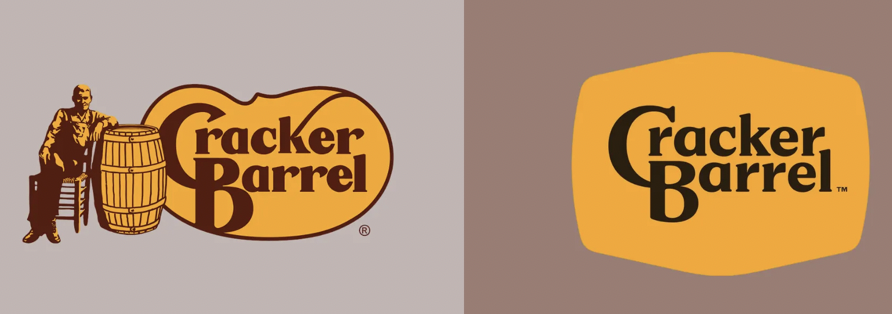
The result was catastrophic. By the end of August, Cracker Barrel had lost US$94 million in market value. Even Donald Trump weighed in on Truth Social stating that “Cracker Barrel should go back to their old logo and admit their mistake”. A week after their rebranding announcement, Cracker Barrel reverted to their original logo. Soon after they ditched their shiny new DEI statements, along with plans to remodel their restaurants and remove their traditional features.
Jaguar’s declared intention to concentrate solely on EVs from 2026 onwards and appeal to a younger audience also led them down the thorny path of rebranding. The new logo is stark, featuring just the word jaguar in lower case letters on a pink backdrop. A rebrand video, which is resonant of London Fashion Week, shows robotic figures stomping around in psychedelic coloured outfits against a background of violent pink. The backlash was swift. “Go woke, go broke” screamed the headlines and Jaguar sales crashed by 97.5% in July. In this case, however, CEO Rawdon Glover has defended the rebrand saying: “We’re fine with polarising. What we shouldn’t do is try and be loved by everybody… you’ll end up with vanilla.”
A logo is a visual symbol that identifies a company, while a brand is the sum of perceptions, values and emotions people associate with that company.
Ultimately, as the share price drops indicate, any organisation that ignores what McNamara describes as the architecture of listening is setting themselves up for failure. A logo is a visual symbol that identifies a company, while a brand is the sum of perceptions, values and emotions people associate with that company. When a business rebrands without listening to its audience, it risks breaking trust and disrupting the emotional connection that stakeholders have carefully built over time.
Ignoring your loyal customers, rebranding and then causing a crisis of your own making? It’s crackers!
Author: Rosie Hamilton, Social Media Manager for CIPR Crisis Communications Network
Banner Photo: Cracker Barrel Old Country Store by Leo Reynolds
Photo: Sydney Burright
Discover more from
Subscribe to get the latest posts sent to your email.